
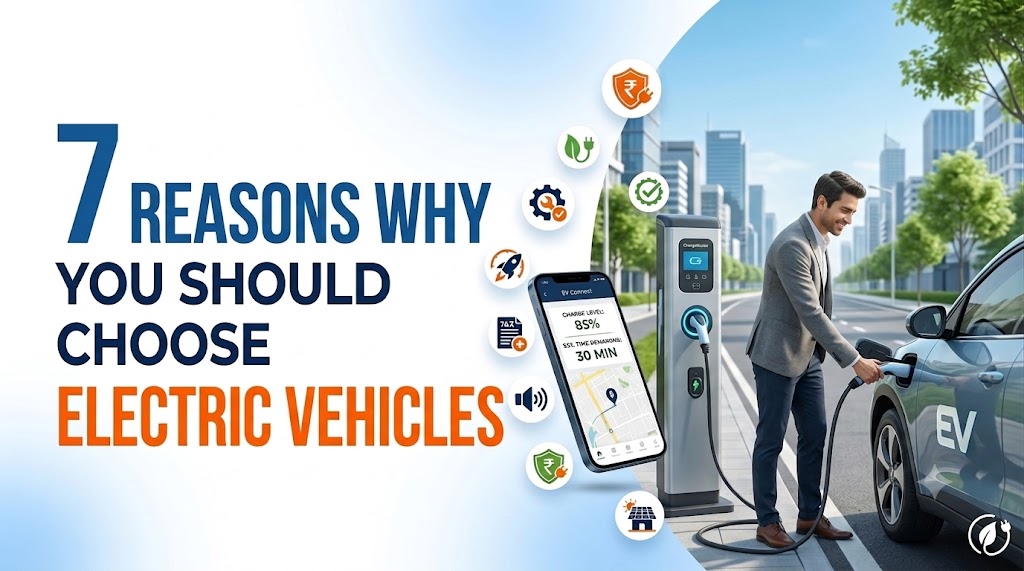
7 Reasons Why You Should Choose Electric Vehicles — and the Real Advantages of Electric Cars Nobody Talks About
Somewhere between 2019 and now, electric vehicles stopped being a talking point at tech events and started showing up in regular middle-class parking lots. That shift didn't happen because of environmental guilt — it happened because the practical advantages of electric cars got genuinely hard to ignore. Here's what that case actually looks like when you break it down honestly.
1. The Cost Per Kilometre Gap Is Wider Than Most People Realise
People compare the sticker price of an EV to a petrol car and stop there. That's where the thinking goes wrong.
Running a petrol car in India costs ₹6 to ₹9 per kilometre. An EV charged at home runs between ₹0.80 and ₹1.50. For someone doing 40 kilometres a day, that's a saving of ₹70,000 to ₹1,00,000 over just three years. Not the vehicle's lifetime — three years. That's before you touch maintenance.
2. Fewer Moving Parts Means Fewer Bills — One of the Biggest Electric Vehicle Benefits Nobody Mentions
A petrol engine has over 2,000 moving parts. An EV motor has around 20. What that means practically: no engine oil, no spark plugs, no timing belt, no exhaust system, no clutch. Brake pads last longer too because regenerative braking handles most of the slowing down.
The service visits petrol owners treat as normal life — ₹8,000 here, ₹15,000 there — simply don't happen at the same frequency. Over five years, this quietly adds up to more than most people budgeted for when they were comparing purchase prices.
3. The Emissions Question Deserves a Straight Answer
The most common pushback: "The electricity comes from coal anyway." Fair question. Even on India's current grid, EVs produce 20-30?wer lifecycle emissions than petrol vehicles when you account for fuel refining and transport.
More importantly, India's renewable energy capacity keeps growing. The same EV gets progressively cleaner every year without any change to the vehicle itself. The benefits of electric cars on emissions aren't perfect today — but they keep improving automatically, which no petrol car can say.
4. The Way It Drives Is Different, and That Difference Stays With You
Petrol engines build power as they rev — press the accelerator and there's a brief pause before momentum comes. Electric motors deliver everything the instant you press the pedal. No delay, no gear change interrupting the flow.
In city traffic this changes the whole texture of driving. Signals, merging, tight gaps — it all happens with a precision that's genuinely hard to go back from. The cabin is quieter too, which after a long day in the city matters more than people expect before they've experienced it.
5. Government Incentives Are Real — But Have a Shelf Life
India's FAME II scheme and state-level EV policies currently offer genuine savings — subsidies, reduced road tax, lower registration fees. Buyers in some states have saved anywhere from ₹10,000 to over ₹1.5 lakh at purchase depending on vehicle category.
The timing matters here. These schemes exist to push adoption, not as a permanent feature. As EVs go mainstream, incentive programmes wind down. The advantages of electric vehicles from government policy are strongest right now, during the early adoption window — not three years from now when the market no longer needs the push.
6. Charging at Home Quietly Removes a Daily Stress
Fuel management is a constant background task with a petrol car — watching the gauge, planning stops, the scramble when you're running late and nearly empty. EV ownership removes that entirely. Plug in overnight, start every morning full.
For city commutes of 40-60 kilometres a day, a standard home charger keeps up without any planning at all. The range anxiety people worry about before buying an EV is mostly relevant for highway trips — in daily city use it simply doesn't come up.
7. The Resale Picture Is Getting Better Every Year
Battery degradation and uncertain resale used to be legitimate concerns. The data from early adopters is now coming in, and it's better than the pessimists predicted. Battery health on well-maintained EVs is holding through real Indian conditions, manufacturers are backing it with 8-year warranties, and the second-hand EV market is finding its footing.
Someone buying today is entering a very different segment from what early buyers faced five years ago — better infrastructure, more buyers, and manufacturers with a long-term stake in making the ownership experience actually work.
Worth Saying Plainly
The advantages of electric cars are strongest for urban commuters with predictable daily distances and access to home charging. Frequent highway drivers have a more nuanced case. But for the majority of Indian buyers, the combination of lower running costs, simpler upkeep, and a better driving experience makes the benefits of EVs hard to dismiss in 2024. The question has quietly shifted from "should I consider one" to "which one fits my situation."
Frequently Asked Questions
What are the real advantages of electric cars beyond the environment?
Lower fuel cost per kilometre, far fewer maintenance visits, instant throttle response, home charging convenience, and real government purchase incentives. For most urban drivers the financial and practical case is actually stronger than the environmental one.
Do the benefits of EVs apply to long-distance driving too?
Increasingly yes. Highway charging infrastructure has improved considerably. Fuel savings on long trips are actually larger than city driving — the electric vehicle benefits on highways are real, just with more route planning involved than city use.
Is battery degradation still a concern?
Much less than before. Most mainstream manufacturers now offer 8-year warranties, and real-world data from early adopters shows better-than-expected health across typical Indian conditions.
Will government incentives continue?
Current schemes have timelines. The advantages of electric vehicles from policy support are strongest now, during the adoption phase — buyers who move earlier in the cycle benefit more.
Are the benefits of electric cars worth the higher upfront cost?
For most buyers yes. The fuel gap alone — ₹1.50/km for an EV versus ₹7-8/km for petrol — typically recovers the price difference within two to three years, with maintenance savings adding further on top.