
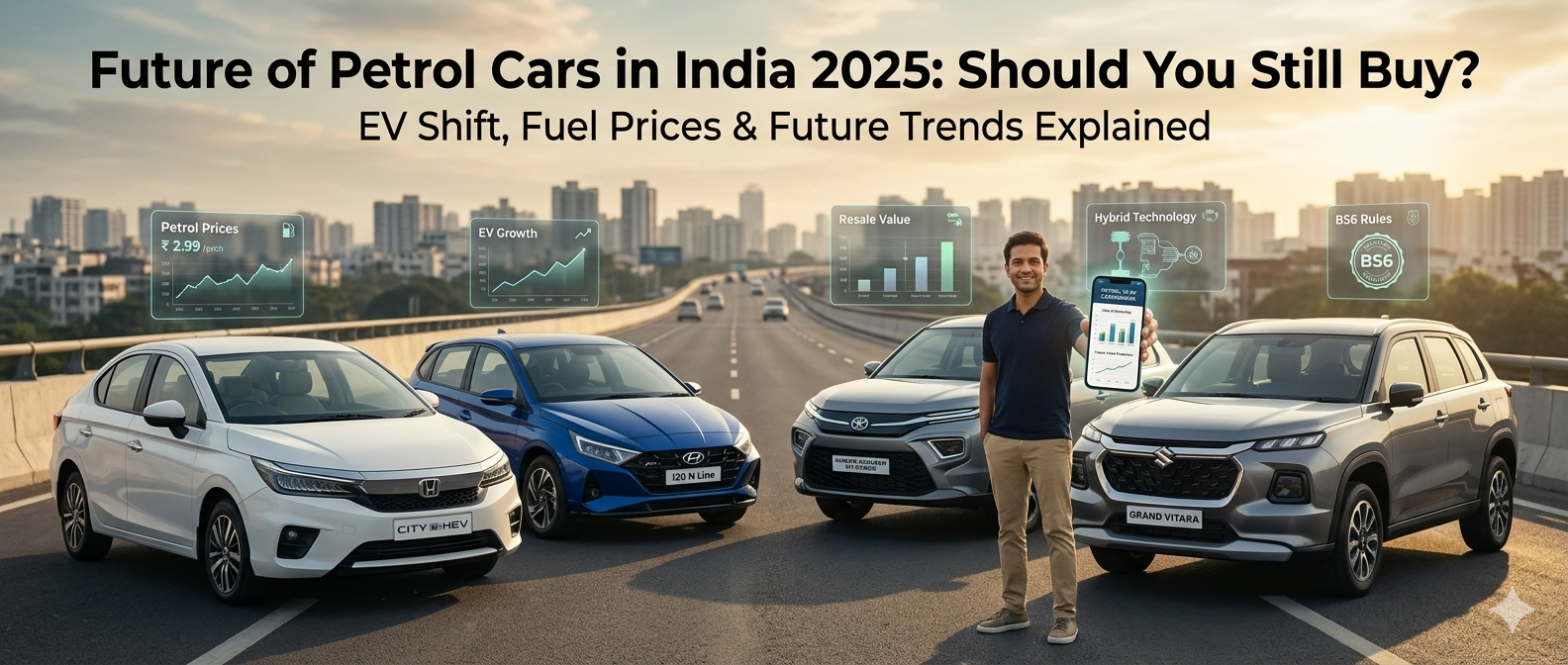
Future of Petrol Cars in India: What Every Buyer Must Know in 2025–2030.
"There is no future for petrol and diesel vehicles," warned Union Minister Nitin Gadkari at Busworld India Conclave 2025 — but millions of Indians still rely on petrol cars daily. So what does the road ahead actually look like?
Every morning, millions of Indian car buyers — from a software engineer in Bengaluru to a schoolteacher in Bhopal — start their petrol car without a second thought. But behind that routine moment, a massive policy and market shift is quietly building. Union Minister Nitin Gadkari has made it clear: petrol and diesel vehicles have no long-term future in India. So what does that actually mean for the average person sitting in a showroom today?
Petrol cars are not disappearing tomorrow — or even by 2030. India has set an ambitious target of 30% EV sales by 2030, which means the remaining 70% of new vehicles sold will still run on conventional fuels for most of this decade. In metro cities like Delhi, Mumbai, and Bengaluru, the shift is already visible — EV penetration has crossed 7% in these markets. But in tier-2 cities and rural India, petrol remains the only practical choice, with charging infrastructure still years away from being reliable. The transition is real, but it will be gradual and deeply uneven across the country.
Petrol cars are not disappearing tomorrow — or even by 2030. India has set an ambitious target of 30% EV sales by 2030, which means the remaining 70% of new vehicles sold will still run on conventional fuels for most of this decade. In metro cities like Delhi, Mumbai, and Bengaluru, the shift is already visible — EV penetration has crossed 7% in these markets. But in tier-2 cities and rural India, petrol remains the only practical choice, with charging infrastructure still years away from being reliable. The transition is real, but it will be gradual and deeply uneven across the country.
The petrol car you buy today is not the petrol car of 2015. BS-VI Phase 2 emission norms — already in force — have cut harmful pollutants dramatically. Add to that the government's E20 ethanol blending programme, which mixes 20% ethanol into petrol at the pump, and even a conventional petrol engine is now running on a meaningfully cleaner fuel mix than it was a decade ago. This is how India is buying time — making petrol cleaner while the EV ecosystem catches up.
Do petrol cars have a future in India?
Yes — but a shrinking and evolving one. Petrol cars are not going to disappear overnight. India has not fixed a ban date for internal combustion engines, unlike the EU's 2035 phaseout. The government's official target is 30% EV sales by 2030, which means 70% of new car sales will still be non-electric for most of this decade.
However, BS-VI Phase 2 norms (already in force) have made petrol engines cleaner than ever. And with ethanol blending reaching E20 (20% ethanol in petrol), even today's petrol cars are running on a greener fuel mix. The real shift will be gradual, not sudden.
"OEMs must mull switching from fossil fuels towards cleaner alternatives. Hydrogen is the fuel of the future — nearly 10 pilot corridors are already operational."
— Nitin Gadkari, Union Minister of Road, Transport & Highways, Busworld India Conclave 2025
| 70% | 8.36% | 3.5% | ₹26,000 Cr |
| New cars in 2030 still projected to be non-EV | Overall EV penetration Q1 FY26 (all segments) | EV share in passenger cars (4-wheelers) | PLI scheme EV investments unlocked |
What will happen to petrol cars after 15 years?
Looking at a 2025–2040 horizon, here is the most realistic roadmap based on current government policy, market data, and global trends:
2025–27
Petrol + Hybrids coexist. Strong hybrids (Toyota, Maruti Grand Vitara) surge in popularity. E20 ethanol blending becomes standard. BS-VI Phase 2 keeps petrol viable and cleaner.
2028–30
EV cost parity approaches. EVs near price parity in passenger car segments. Highway charging network covers every 10–15 km. Government targets 30% EV sales. Petrol still dominates tier-2/3 cities.
2030–35
Petrol sales decline but not banned. No formal ICE ban in India unlike EU. Petrol cars become niche in metros. Resale values drop. Insurance costs may rise. Fuel stations in cities reduce.
2035–40
Petrol becomes premium/rural fuel. New petrol-only car launches shrink significantly. Most new launches are hybrid, EV, or hydrogen. Existing petrol cars remain road-legal but face higher costs.
Note: India has not announced a fixed ban year for petrol/diesel cars. The 2040 scenario is a projection based on current policy trajectory, not a confirmed government date.
Should you buy a petrol car in 2026?
The honest answer: it depends on your situation. Here is a structured comparison to help you decide.
Buy petrol if…
- Monthly usage is under 800 km
- You frequently drive inter-city without charging access
- Budget is tight — EVs carry a ₹1.1–1.5 lakh premium post-GST rationalisation
- You live in a tier-2/3 city with limited charging infra
- You prefer a wider service network and familiar maintenance
Buy Ev/ Hybrid if…
- You drive 1,200+ km/month in a metro
- You have home charging access
- You plan to keep the car 4–5+ years (savings compound)
- You want lower running costs (₹1–1.5/km vs ₹6–8/km petrol)
- Strong hybrid is a great middle path — no range anxiety, 27+ kmpl
In which year will petrol finish in India?
Petrol will not simply "finish" — it will gradually become less dominant. Global oil demand peaked around 2025–26 per IEA projections, but in India, petrol consumption is expected to remain significant through 2030 and beyond for the following reasons:
India has over 300 million registered vehicles on the road today. Even if all new sales became electric tomorrow, existing petrol vehicles would keep fuel demand alive for 15–20 years. Additionally, crude oil prices remain politically sensitive — the government has maintained pump prices despite a 133% rise in crude basket costs since early 2025, absorbing losses of ₹13.50/litre on diesel.
The more realistic picture: petrol's role will shrink from primary transport fuel to a niche and rural fuel over a 20–30 year horizon. There is no government-announced year for petrol to be phased out in India.
FAQ (Frequently Asked Questions)
What will happen to petrol cars after 2030 in India?
After 2030, petrol cars will remain legal to own and drive in India — there is no confirmed ban. However, new petrol-only launches will shrink significantly, fuel prices may rise as volumes drop, and resale values will decline faster than today. Cities may restrict older petrol vehicles in low-emission zones similar to Delhi's odd-even policies. Most automakers will pivot to hybrids and EVs as their primary offerings. Petrol will persist in rural India and for niche applications well into the 2030s.
What is the future of diesel cars in India?
Diesel cars face a tougher future than petrol. Delhi already banned diesel vehicles over 10 years old in 2015. Multiple states are tightening diesel norms. In the sub-₹20 lakh segment, diesel variants are being discontinued by brands like Maruti, Hyundai, and Kia. For trucks and commercial vehicles, diesel remains strong but is being challenged by CNG, LNG, and hydrogen pilots by Tata, Ashok Leyland, and Mahindra. Diesel passenger cars will likely become rare new-vehicle options by 2028–30.
Electric + petrol car in India — what are hybrids and their prices?
Hybrid cars combine a petrol engine with an electric motor. Three types exist in India: Mild Hybrid (small electric assist — e.g. MG Hector, Maruti models), Strong Hybrid (can run in pure EV mode — Toyota Hyryder, Grand Vitara at ₹16–20 lakh), and Plug-in Hybrid/PHEV (larger battery, chargeable externally — upcoming MG 520 at ~₹25–30 lakh, BYD Sealion 6 at ~₹30–40 lakh). Strong hybrids offer 22–28 kmpl real-world and are the fastest-growing segment in India in 2025–26.
Petrol or EV — which is better in India?
For city drivers covering 1,200+ km/month with home charging: EV wins on total cost of ownership — running costs of ₹1–1.5/km vs ₹6–8/km for petrol. For low-mileage drivers, inter-city travellers, or those without home charging: petrol remains practical and cost-effective upfront. For the best compromise: a strong hybrid. It delivers ~27 kmpl, no range anxiety, and saves significantly on fuel without needing a charger at home.
Price difference between EV and petrol car in India?
EVs carry a ₹1.1–1.5 lakh premium over comparable petrol cars in the passenger segment, widened slightly after GST rationalisation on ICE vehicles in September 2025. However, GST on EVs is just 5% vs 28% on ICE vehicles — a 23-point structural advantage. Battery prices have fallen to $100/kWh globally, and EVs are projected to reach cost parity around 2030 in several segments. Currently, the Tata Nexon EV starts at ~₹14.5 lakh vs the Nexon petrol at ~₹7.5 lakh — though running costs for the EV are 4–5x lower per km.
Upcoming petrol cars in India 2025 — key launches?
Key 2025 petrol launches included Kia Syros (₹10–14 lakh, sub-compact SUV), Tata Harrier Petrol (1.5L turbo, ~₹15 lakh), Tata Altroz Facelift, and Renault Duster (₹10 lakh onwards). In 2026, major upcoming petrol cars include Maruti Brezza Facelift (~₹8.5L), Hyundai Verna Facelift (~₹12L), VW Taigun Facelift (~₹14L), and the VW Golf GTI (~₹50L) for enthusiasts. Around 28 petrol models are expected to launch in 2026–27 across all segments from budget to premium.